Opota reads the official French control results for any commune and answers in one screen: a colour, a score out of 100, and every value the laboratory measured.
Built on Hub’Eau, the French open-data service for water. No account, no tracking.
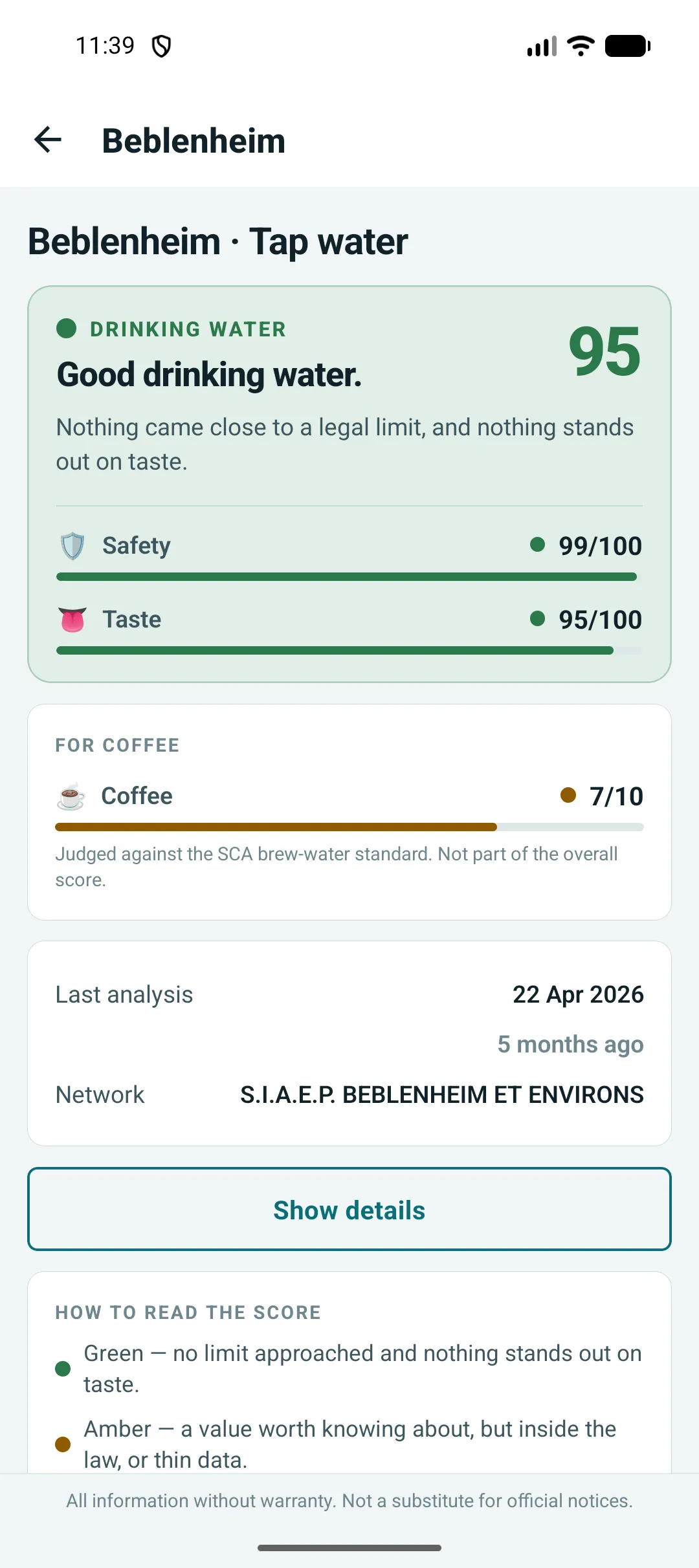
Drinking water
Good drinking water.
95
Nothing came close to a legal limit, and nothing stands out on taste.
🛡️Safety
99/100
👅Taste
95/100
☕Coffee
7/10
Judged against the SCA brew-water standard. Never part of the overall score.
Last analysis
22 Apr 2026
Network
S.I.A.E.P. Beblenheim et environs
What the app shows, for Beblenheim in Alsace
Four taps from a question to an answer
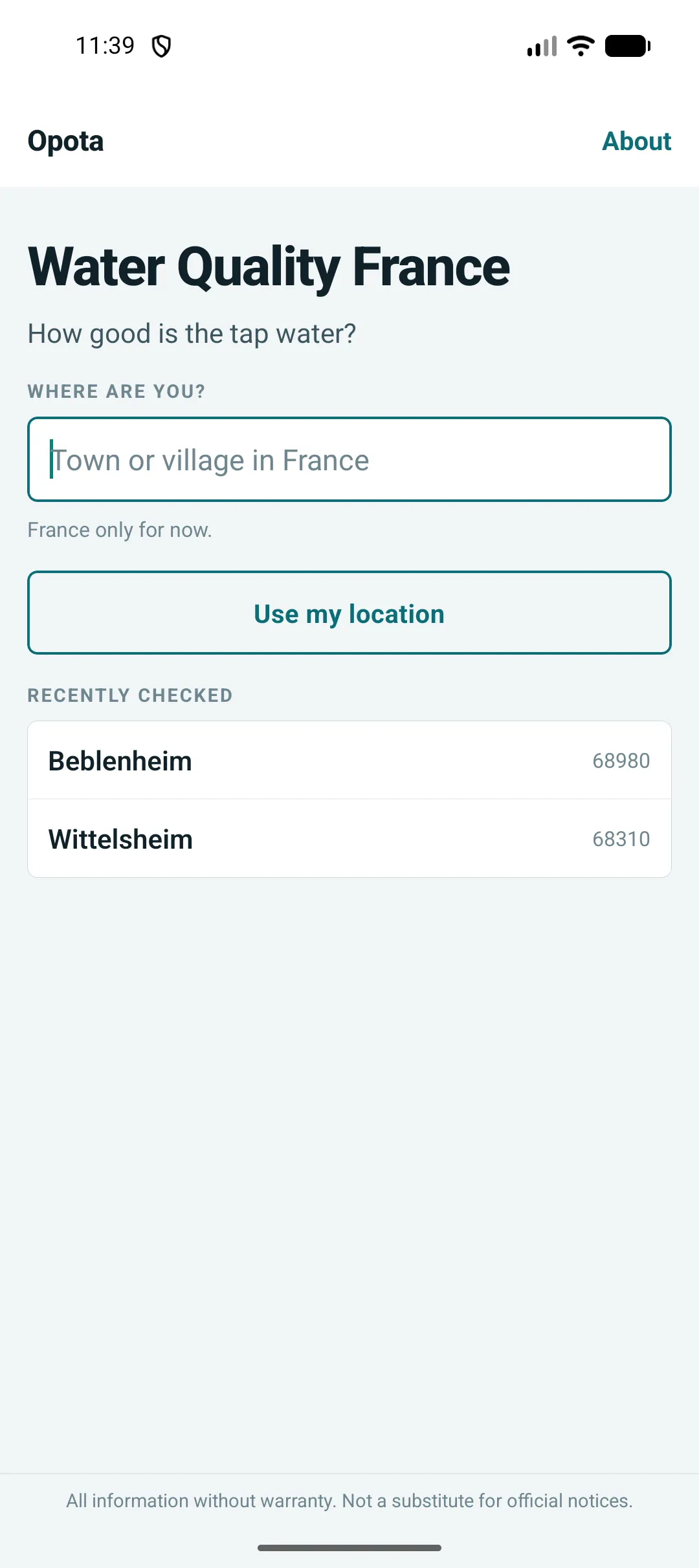
Type a place or use your location, read the verdict, then open the breakdown if you want to see which parameter moved the number.
Find the commune
Type a name, or let the app turn your position into a commune. Places you have looked up stay one tap away.
Read the verdict
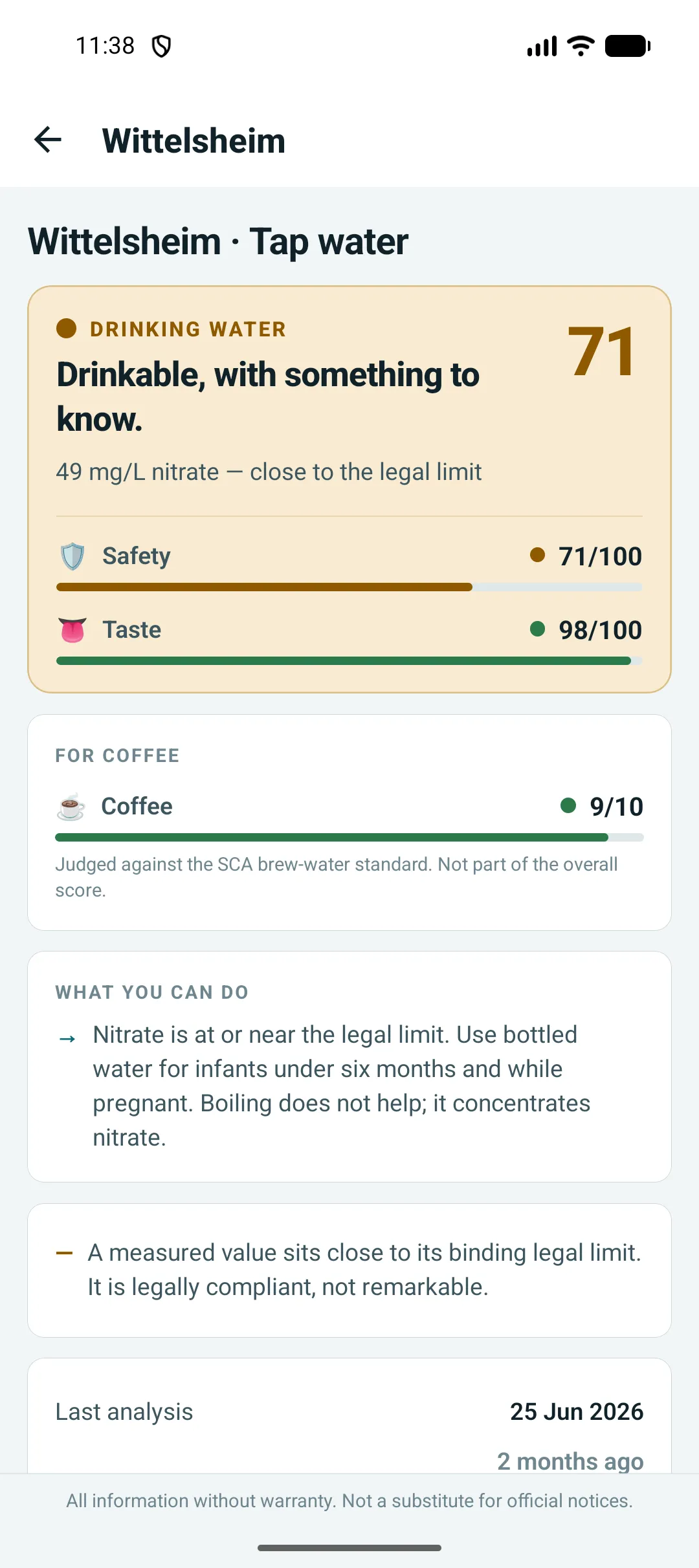
Amber means a value worth knowing about, inside the law. Wittelsheim measures 49 mg/L of nitrate against a limit of 50 — legally compliant, and worth seeing.
And the good news too
Green needs both halves: nothing near a limit, and nothing that stands out on taste.
See every value
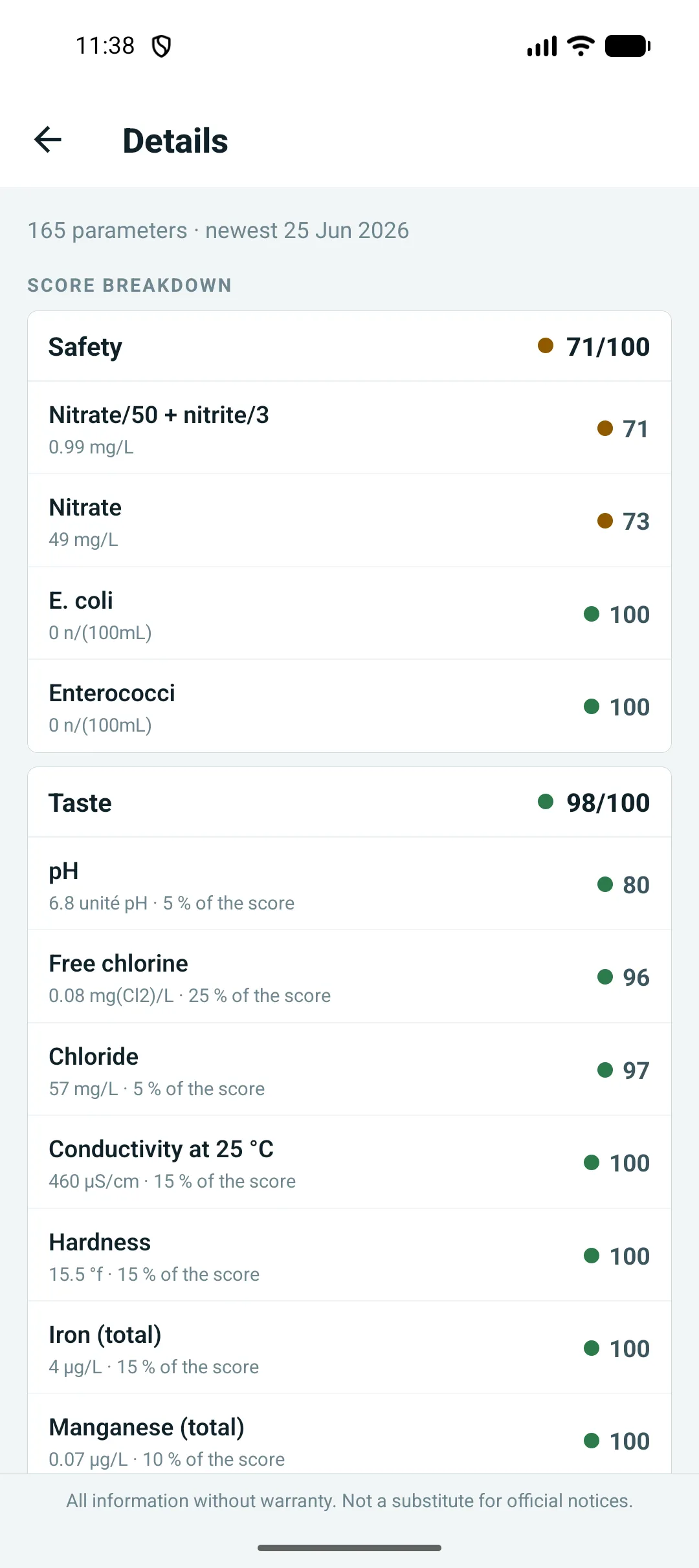
Each parameter with its measurement, its share of the score and its own colour. Nothing is hidden behind the number.
Three scores, because they answer three questions
The overall score is the lower of safety and taste — water is only as good as its weaker half. Coffee is reported separately and never counted in.
🛡️Safety
How close does the worst measured value come to its binding legal limit?
Only parameters carrying a limite de qualité — the binding health limit — are scored, and the score is the worst of them rather than an average. The health authority’s own verdict on the sample is a ceiling: an official non-conformity can never be scored green.
Green from 95, amber from 70
👅Taste
Is it likely to taste the way you expect from good water?
A weighted average of what people actually notice: chlorine, mineralisation, hardness, iron, manganese, chloride, sulphate, pH and clarity. Only parameters that were really measured count, and below 40 % coverage no taste score is shown at all.
Green from 80, amber from 60
☕Coffee
Does it make good brew water?
Alkalinity, calcium hardness, dissolved solids and chlorine against the Specialty Coffee Association target ranges. Kept out of the overall score deliberately: very soft water is perfectly good to drink and still makes thin, sour coffee.
Shown out of 10
What the colour means
The colour follows the bands, not the number. Safety turns green at 95 and taste at 80, because a judgement about taste is read more loosely than one about a legal limit — so a single figure could not carry both.
🛡️ Safety0 – 100
07095100
👅 Taste0 – 100
06080100
Green is only possible when safety and taste are both green. One red row can never sit inside a green score.
Green
No limit approached, and nothing stands out on taste.
Amber
A value worth knowing about, but inside the law — or thin data.
Red
A limit was exceeded, or the authority itself found the sample non-compliant.
The numbers are the state’s, not ours
Every value comes from Hub’Eau, the French open-data service for water, which publishes the sanitary control results collected by the regional health agencies (ARS) under SISE-Eaux. Opota measures nothing itself and never alters a published value.
Results appear once the authority has validated them, which usually takes two to five months. The date on a result is always the real sampling date, and every verdict is phrased in the past tense: what the last analysis found, never what the water is right now.
Boil-water notices, burst mains and other short-term restrictions are not in Hub’Eau, and there is no national machine-readable source for them. Every result links to the ARS responsible for that commune.
Your building
The analysis stops at the meter. Old indoor plumbing can add lead or copper after it, and no published dataset can see inside a house.
The actual glass
Taste and coffee are calculated from chemistry, not tasted. They are a good indication, not a verdict on what is in front of you.
Opota is an information app. It is not medical or legal advice and not a substitute for your water utility or your local health authority.
Your location: used once, then forgotten
There is no account, no registration, no analytics, no advertising and no tracking. The app’s requests pass through one small server of ours in Germany, which hands them on to the French address service and Hub’Eau and keeps nothing about you.
Location is never requested at launch. It is sent only when you tap “Use my location”, through our server to the French administration’s geocoding service — it never leaves the EU and is not stored or logged anywhere. Decline the permission and type the place name instead; the app does everything it otherwise does.
Recent communes and cached results stay on the device
Three communes free, for good
Not three per week — three, permanently. A commune you have already opened stays free forever, and a lookup that dies on a bad connection never costs you one.
Week
€1.99
renews weekly until cancelled
Lifetime
€24.99
pay once, no expiry
Both unlock the same thing
Unlimited communes
Every future feature of the app
Support with an answer within 24 hours on business days
Purchases run through the app store you installed from — Google Play or the App Store — which is the seller. We receive no payment data: the app only asks the store whether a valid purchase exists for that store account.
France only, for now. The data source is the French sanitary control programme; there is no equivalent open dataset for Austria, and Belgium would mean three regional sources. If a second country arrives it will be because a source good enough exists, not because a map looked better with two.
How current are the results?
A result is published once the regional health agency has validated the sample, typically two to five months after it was taken. Opota always shows the sampling date and says how long ago it was; a sample older than twelve months lowers the safety score by itself.
Why is a compliant result sometimes amber?
Because “within the limit” and “nowhere near the limit” are not the same news. Wittelsheim measures 49 mg/L of nitrate against a limit of 50. The authority rates the sample compliant, and it is — but showing that as plain green would be true and misleading at once.
Does it work offline?
A result you have already opened stays readable without a connection, from the cache on the device. A commune you have not looked up yet needs the network, because that is when the analysis is fetched.
Is there an iPhone / Android version?
Yes — on the App Store for iPhone and iPad, as on Google Play for Android. A purchase belongs to the store account that made it; if you move platforms later, write to us with your order number and we will transfer a lifetime purchase free of charge.
Who makes it?
Le Bon Mot GmbH in Vienna. The name comes from eau potable — drinking water.